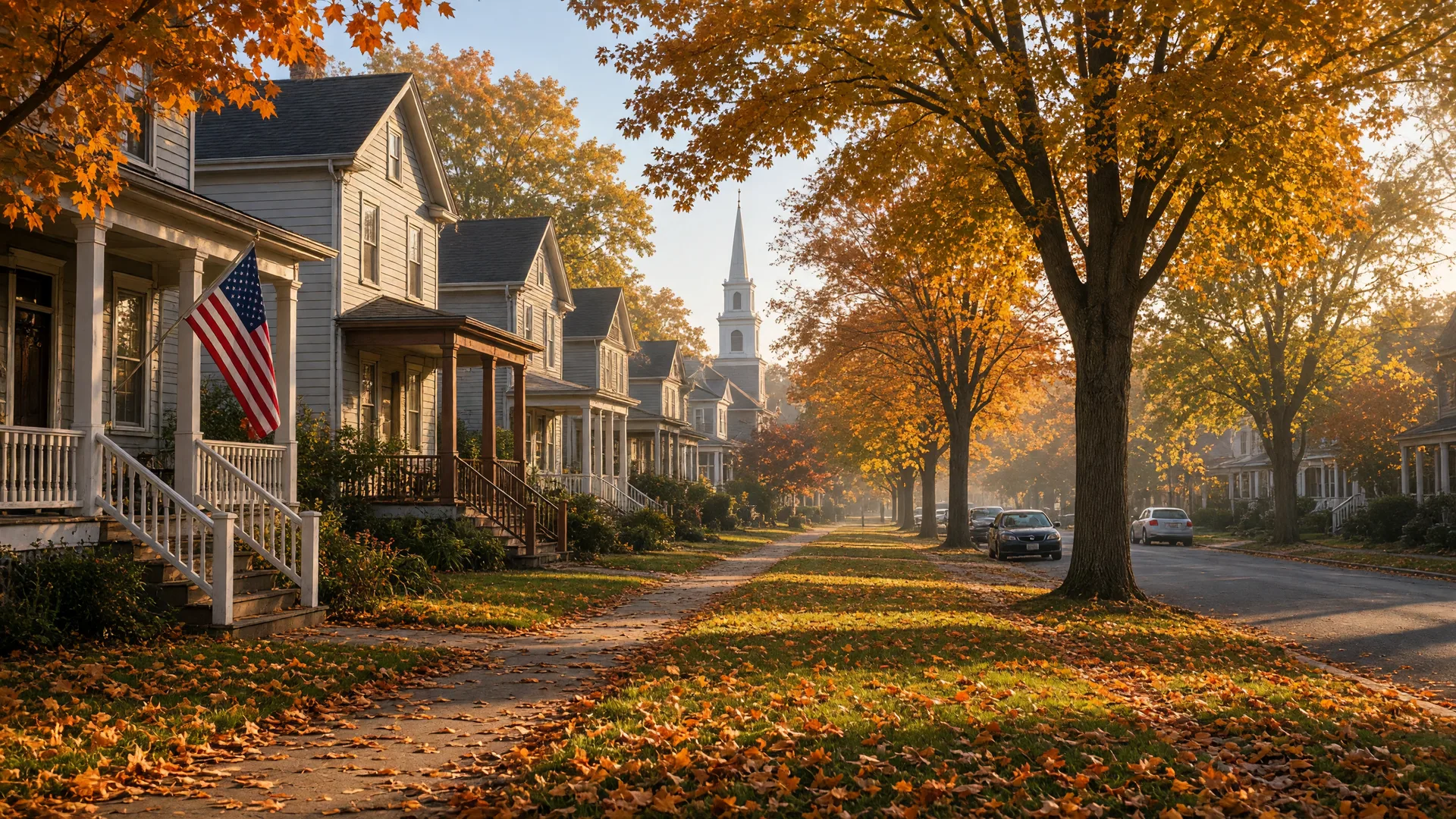
Falls Church, Virginia is a 2.2-square-mile independent city tucked between Arlington and Fairfax counties, about six or seven miles west of downtown Washington, D.C., with roughly 15,159 residents as of the Census Bureau's July 1, 2025 estimate. It is served end to end by one of the region's smallest and most distinctive school divisions, Falls Church City Public Schools (FCCPS), a PreK through 12th grade International Baccalaureate (IB) World School system, and two Metrorail stations sit at its edges. This guide covers what the data actually says about the city known as the Little City right now, from 2026 home prices to schools, taxes, commute, and local life. Every figure below is sourced and dated so you can verify it yourself.
Falls Church, Virginia at a Glance
- Population
- 15,159 (Census Bureau, July 1, 2025 estimate)
- Land area
- 2.2 square miles (independent city since 1948)
- Median sale price
- $899,447 (Redfin, September 2026)
- Median household income
- $143,262 (Census ACS 2020–2024)
- School district
- Falls Church City Public Schools, PreK–12 IB World School district
- Real estate tax rate
- $1.185 per $100 assessed value (city, 2026)
- Closest Metro
- East Falls Church (Orange & Silver); West Falls Church (Orange)
- Distance to downtown D.C.
- Roughly 6–7 miles west of downtown Washington, D.C.
A quick note on the numbers: Redfin figures are for the City of Falls Church and ZIP 22046, September 2026. Household income and property value figures come from the U.S. Census Bureau's American Community Survey 2020–2024 five-year estimates. Countywide context is from NVAR market statistics for September 2026, data via Bright MLS. Tax rates are the city and county rates adopted for 2026. School figures are from FCCPS, the Virginia School Quality Profiles, and Meridian High School. All were current as of November 2026.
Is It Really "the Little City"? And Why the Address Matters
The city is called the Little City for a reason: at 2.2 square miles, it is small enough that you recognize half the faces at the farmers market by the second weekend. Falls Church was incorporated as a town in 1875 and became an independent city in 1948, which in Virginia means it operates as its own county-equivalent, with its own schools, its own police, and its own budget. The city is named for The Falls Church, the Episcopal parish whose founding dates to the 1730s and whose brick church, designed by Col. James Wren, was built 1767 through 1769 at what is now 115 East Fairfax Street. George Washington was elected a vestryman of Truro Parish on October 3, 1763, and then, with George William Fairfax, was appointed a church warden to contract that brick building, according to church and local histories.
Here is the distinction that matters when you shop for a home: a Falls Church mailing address is not the same as living inside the City of Falls Church. The city's 2.2 square miles are served almost entirely by FCCPS. It sits in ZIP 22046, but 22046 also reaches into Fairfax County. Meanwhile large parts of ZIPs 22042, 22043, and 22044 carry Falls Church street addresses while legally being in Fairfax County, served by Fairfax County Public Schools and by Fairfax County, not the city. That is a practical difference, not a cosmetic one. It changes your school assignment, your property tax rate, your trash and leaf service, and even your voting jurisdictions.
The property tax split is a concrete example. For 2026, the City of Falls Church real estate tax rate is $1.185 per $100 of assessed value, while Fairfax County's 2026 rate is $1.12 per $100, per each locality's official tax-rate pages. The city's higher rate buys you its own small school division and city services, and on a $1 million home the gap works out to roughly $650 a year. It is a modest difference, but it is real, and it is one of the reasons a city home and a county home can feel like different purchases even on the same street.
The practical takeaway: if the FCCPS schools and the city government are part of what you are buying, confirm the property is inside the corporate limits of the City of Falls Church, not just inside a Falls Church ZIP code. A good agent will pull the legal description and school-finder result for the exact address before you fall in love with a listing.
Schools: An Entire District on the IB Continuum
FCCPS is the reason many families cross the line into the city. The entire division is an IB World School system: all five schools are IB-certified, which is unusual anywhere, and rare in Virginia. The elementary years run through the IB Primary Years Programme (PYP), middle school through the Middle Years Programme (MYP), and Meridian High School carries the MYP plus the IB Diploma Programme and Career-Related Programme. District enrollment was about 2,742 students as of March 2025, per FCCPS materials, small enough that teachers and principals know your family by name.
5
Schools, all IB-certified
~2,742
District students (March 2025)
92%
IB participation at Meridian HS
The path runs Jessie Thackrey Preschool (ages two to five), Mount Daniel Elementary (kindergarten through grade 2), Oak Street Elementary (grades 3 through 5), Mary Ellen Henderson Middle School (grades 6 through 8), and Meridian High School (grades 9 through 12), which was renamed from George Mason High School and traces its IB tradition back to when the school, as George Mason, became the first high school in Virginia to offer the program. Meridian enrolled 913 students in the 2025–2026 school year, per the Virginia School Quality Profiles, and the Class of 2026 included 68 IB Diploma candidates and 22 Career-Related Programme completers, according to the school.
The flip side of the city's smallness: FCCPS has exactly one high school, so there is no pyramid shopping within the city. Your child is on the IB path by default, which is exactly what some families want and a real consideration for families who prefer a different high-school model. And remember the boundary rule: FCCPS serves the city proper, not every address that carries a Falls Church ZIP. Before you write an offer, run the exact address through the district's boundary lookup and confirm your assignment for the school year.
Getting to Work: Two Metro Stations, Two Lines, One Short Ride
Falls Church is one of the few Northern Virginia cities with real transit stamped on both edges. East Falls Church station, at 2001 North Sycamore Street just across the Arlington line, opened June 7, 1986, and is served by the Orange and Silver lines, with 422 parking spaces per WMATA. It is the junction where the Orange Line continues west toward Vienna and the Silver Line diverges northwest toward Tysons, Reston, and Dulles. West Falls Church station, at 7040 Haycock Road, also opened June 7, 1986, sits on the Orange Line only, and anchors a much larger park-and-ride with about 2,009 spaces in its six-level garage and surface lots. Roughly a 20-minute ride on either line gets you into downtown Washington, which is a genuinely short Metro commute by regional standards.
One caveat worth knowing before you plan around it: WMATA has been redeveloping the West Falls Church station area since November 2025, and portions of its lots are closed while construction proceeds, with riders directed to the onsite garage. Check current WMATA advisories before you assume the surface lots will be waiting. And if you drive, know the rules: Interstate 66 inside the Beltway enforces HOV-2+ restrictions and dynamic tolls during peak hours, while U.S. 29 (Lee Highway) and U.S. 7 (Leesburg Pike) bracket the city and run toward D.C. and Tysons respectively.
Before you commit to a commute: test your real trip twice. Metro station parking fills early, express lane tolls move with demand, and a route that reads fine on a map at 2 p.m. can feel very different at 8 a.m. Try the full door-to-door, including the walk to the platform.
What Homes Cost in Falls Church in 2026
Falls Church is not a bargain, and nobody should pretend otherwise. Redfin reported a median sale price of $899,447 for the City of Falls Church in September 2026, up 5.8% year over year. Inside the city's core ZIP 22046, where most of the city's addresses sit, Redfin reported a median sale price of $1.1 million over the three months through September 2026, up 8.7% year over year. That ZIP premium is the real story: the city's own inventory skews toward revamped mid-century ramblers, colonials, and newer infill, and demand for its walkable lot sizes and its schools keeps pushing prices toward the million-dollar mark.
$899,447
City median sale price
+5.8% YoY, Sept. 2026
$1.1M
ZIP 22046 median sale price
+8.7% YoY, 3 mo. thru Sept. 2026
~$1.06M
Median property value
Census ACS 2020–2024
Sources: Redfin Falls Church city and ZIP 22046 housing market data, September 2026; U.S. Census Bureau American Community Survey 2020–2024 five-year estimates; NVAR market statistics for Fairfax County, September 2026, data via Bright MLS.
For context on the wider market, NVAR reported a Fairfax County median sold price of $749,750 in September 2026, up 5.6% year over year, with 897 closed sales, 2,326 active listings, and an average of 26 days on market, data via Bright MLS. The county numbers pool everything from Burke townhouses to McLean estates, so the city's $900K median is best read as a premium for what the Little City offers: its own schools, its own police, a walkable downtown, and two Metro stations at the door. You pay for the package, and the package is genuinely different from unincorporated Fairfax County.
I keep the broader trend current on the market report page, and the Falls Church community guide covers the neighborhoods in more detail, with the Fairfax County guide showing how homes just past the line compare. For any specific house, though, nothing replaces a close comparative look at the actual block: lot size, renovation history, school assignment, and what sold within a half mile in the last 90 days.
Local Life: Theater, the Farmers Market, and "Little Saigon"
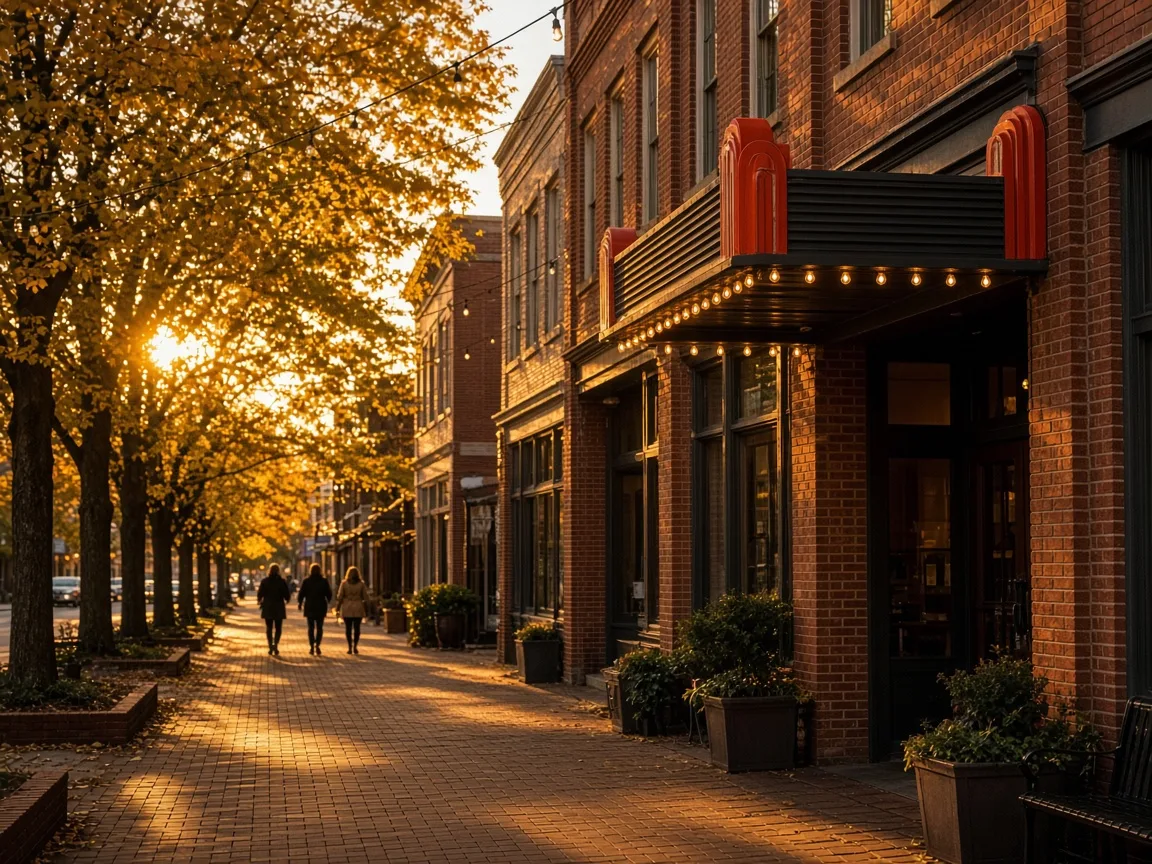
For all its size, the Little City has genuine cultural anchors. The State Theatre at 220 North Washington Street is a restored 1930s art-deco venue that closed in 1983 and reopened in the 1990s as a live-music and performance room, and it still books national touring acts within walking distance of the restaurants on Broad Street. The Falls Church Farmers Market runs Saturdays year-round in the City Hall parking lot at 300 Park Avenue, 8 a.m. to noon April through December and 9 a.m. to noon January through March, per the city's recreation materials. Cherry Hill Farmhouse, the 1845 Greek Revival farmhouse and 1856 barn at 312 Park Avenue, is operated as a museum by the city. And the Tinner Hill Arch in the city's Crossroads area marks one of the region's notable African American heritage sites, the community around which the Tinner Hill neighborhood grew.
Just across the line toward Seven Corners sits Eden Center at 6751–6799 Wilson Boulevard, the largest Vietnamese commercial center on the East Coast and a destination people drive across the region to visit. It opened in 1962 as the Plaza Seven Shopping Center and took the Eden Center name in 1984, when Vietnamese-owned businesses displaced from Arlington's Clarendon settled there, and today it holds more than 120 Vietnamese-owned businesses, including more than 30 restaurants and over a dozen bakeries and cafes, from pho and banh mi to boba and groceries, anchored by its clock tower modeled on downtown Saigon. It is, hands down, my first answer when someone asks where to eat Vietnamese food in Northern Virginia.
A few dependable dining stops inside the Little City itself, with addresses so you can find them: Dogwood Tavern at 132 West Broad Street, the long-running Broad Street tavern; Dolan Uyghur Restaurant at 400 South Maple Avenue, serving Central Asian fare; Lee's Thai Food at 312B South Washington Street; El Taquito Restaurante Bar & Grill at 3013 Annandale Road; and Anthony's Restaurant at 3000 Annandale Road. None of these are secrets, which is exactly the point: they are the places locals actually rotate through.
And if you are reading this in the holiday season, the Little City knows how to close the year: Winter Wonderland in the Little City returns Tuesday, December 1 at Modera Founders Row with live music and Santa, and the Little City Holiday Market lines West Broad Street on Saturday, December 12. Both are on the schedule in my 2026 holiday events guide, with dates confirmed against official sources.
Who Falls Church Is Really For
Falls Church is for the buyer who wants a small-town center of gravity with D.C. and the tech corridor within reach: walkable Broad Street and Washington Street, a school division small enough to know your child's name, two Metro lines within a 10-minute drive, and a farmers market that is the social hub of the week. It suits families who have decided an IB-continuum education is the whole point, empty-nesters who want to park the car and stroll, and D.C. and Pentagon commuters who refuse to give up a real downtown.
It is not for everyone, and I say that with affection. You pay a million-dollar-plus premium for a 2.2-square-mile city with small lots and committed taxes, and if you want the acre-plus yard or the sprawling new-build floor plan, the better value is 10 minutes out in Fairfax or Loudoun counties. That is not a compromise; it is a choice, and the data makes it clear enough to decide on. If you are weighing the Little City against a county address, that is exactly the conversation I love to have.
Thinking About the Little City?
Whether you are weighing a Falls Church City address against a Fairfax County one, or you just want a current, honest price read on a specific home, I would love to help. I have served Northern Virginia and the Maryland suburbs of Washington, D.C. for 24 years, and I know exactly how these boundary distinctions play out in real offers. Text or call me at (703) 623-3476 and let's talk about it.